
01Guide · Dental sintering
Zirconia discoloration and the furnace heating elements
Discoloured zirconia is often blamed on the heating elements. The furnace makers’ manuals point to one specific link – a flaking oxide layer on the elements – and describe cleaning and a cleaning firing before any replacement. What they say, with sources, and a checklist.
Before replacinginspect · clean · cleaning firing · check liquids
Last updated 20 October 2026
Short answer
In the manuals we read, the heating-element link to discoloration is contamination: Ivoclar writes that chipping of the elements’ oxide / protective layer may affect the optical properties (discolouration) of the sintered object [1][2]. The remedy described is cleaning the chamber and a cleaning firing; Ivoclar recommends new elements if there is no improvement after several cleaning cycles [2]. A test by a MoSi2 element supplier found that molybdenum oxide (MoO3) did not discolour zirconia, while iron, chromium and magnesium oxides did [6].
Manuals: what four furnace makers say
Each row paraphrases the maker’s own document for its own furnace. Programs, temperatures and intervals differ between models – follow the manual of your furnace.
| Furnace maker | What the document says | What it tells you to do |
|---|---|---|
| Ivoclar Programat S1, S1 1600 | Chipping of the oxide / protective layer on the heating elements can contaminate the chamber and may affect the optical properties (discolouration) of the sintered object. Signs: clearly visible glassy, transparent particles or fine glass dust on the insulation of the lower part of the furnace, the sinter tray rest or the cooling tray [1][2]. | Inspect the chamber before every sintering. Clean with the brush supplied, never with compressed air, then run Program 1 with the chamber empty. For severe contamination run the cleaning program, repeated until the elements look glassy, with no zirconia in the furnace. No improvement after several cleaning cycles: Ivoclar recommends replacing the heating elements [1][2]. |
| VITA ZYRCOMAT 6000 MS | In speed mode the fast heating puts an extreme burden on the elements and may crack their smooth grey oxide layer. If the layer peels off, splintered glass particles can contaminate the sintering socket or dish [3]. | Check visually at regular intervals for glass particles or glass dust and remove them with a vacuum system, never compressed air. If the grey oxide layer has chipped, a cleaning firing is imperative; it reinstates the layer [3]. |
| Shenpaz Sintra, Sintra Plus | The Degassing parameter purges the muffle during the cycle when acid-based colorants, newer translucent zirconia or pre-shaded zirconia are used. Advanced Degassing expels possible oxide fumes caused by pre-shaded zirconia [4]. | Degassing flushes the muffle for 30 seconds at every 100 °C step, up to a set value of max. 1300 °C, and needs an air-pressure connection. It is set per program [4]. |
| Nabertherm LHT 01/17 D – 03/17 D | Above 800 °C a silicon oxide layer forms on MoSi2 elements and protects them. Without it, oxidation around 550 °C can produce a yellowish powder, mainly MoO3; Nabertherm writes that this has no disadvantageous effect on the performance of the heating element [5]. | To build the protective layer, heat to 100 °C below the furnace’s maximum temperature and hold for about 5 hours – at start-up, after replacing elements, or to regenerate the oxide layer [5]. |
MoO3: is molybdenum oxide to blame?
It is often said that MoO3 released by MoSi2 heating elements discolours zirconia. Schupp, a supplier of MoSi2 heating elements, writes that this is not accurate [6]. In its test, different oxides were dissolved in a liquid and dripped onto zirconia samples. After sintering, the samples treated with MoO3 showed no discoloration; Cr2O3, MgO and in particular Fe2O3 did, some of them considerably, and a colorimeter confirmed the visual result [6].
Schupp attributes the discoloration it measured to oxides – above all iron oxide – released by heating elements of standard MoSi2 qualities, and recommends its own high-purity elements [6]. It is a supplier’s own test, not an independent study.
Nabertherm describes the yellowish MoO3 powder that can form on unprotected MoSi2 elements around 550 °C as having no disadvantageous effect on the performance of the element [5]; that passage does not discuss colour.
Colouring liquids and drying
Schupp also points at colouring liquids: if a coloured blank is not dried enough, the liquid evaporates during firing, spreads in the furnace and contaminates the heating elements and the insulation, which can discolour later zirconia work. It suggests firing in a closed saggar; in its test, a sample inside a closed saggar and one on top of it, in the same run in a contaminated furnace, differed considerably in colour [6].
Ivoclar’s notes for colouring liquids: clean contaminated areas with a soft cloth after sintering, run a cleaning firing if the chamber or insulation is severely contaminated, and pre-dry stained restorations in a pre-drying furnace – air drying is not sufficient [2].
What this means for a replacement
If the oxide layer keeps flaking after several cleaning firings, new elements are the furnace maker’s own advice [2]. If the elements look smooth and glassy, the documents above point to other sources of contamination – colouring liquids, drying, the tray or the chamber [2][6] – and new elements alone may not change the colour.
Checklist: before you replace the elements
- Inspect the chamber before sintering. Glassy particles or fine glass dust on the insulation, the tray rest or the cooling tray point to a flaking oxide layer [1][3].
- Look at the elements. Ivoclar describes an intact layer as glassy, VITA as smooth and grey; chipped, flaking areas are the warning sign [1][3].
- Clean the chamber the way your manual says – brush or vacuum, never compressed air [1][3].
- Run the cleaning or oxidation firing from your furnace manual with no zirconia in the chamber, and repeat it if the layer is not yet even [1][3][5].
- Check the sinter tray: Ivoclar asks for it to be kept free of dust and notes that contact reactions at high temperature can show as white spots [2].
- Check colouring liquids and drying: Ivoclar asks for stained restorations to be pre-dried in a pre-drying furnace [2]; Schupp describes contamination from blanks that were not dried enough [6]. If your furnace has a degassing or purge function, see how its maker describes it [4].
- If the layer still flakes after several cleaning cycles, plan new elements [2]. Send us the furnace model, the serial number and a photo of the old element next to a ruler.
This checklist summarises the documents listed under Sources. It does not replace your furnace’s manual or its service.
Your furnace model
What each furnace maker documents about its elements: type, number per furnace, item numbers and replacement notes. Measuring an old element: MoSi2 element sizes.
Programat S1 / S1 1600
Cleaning firings, Service Hint 1700, and when Ivoclar recommends new elements.
Details and sources →Dentsply SironainFire HTC speed
Six MoSi elements, the resistance check and the counter reset after a replacement.
Details and sources →ShenpazSintra / Sintra Plus
Three elements; Shenpaz recommends changing all three after 2,000 working hours above 500 °C.
Details and sources →NaberthermLHT 01/17 D / 03/17 D
Molybdenum disilicide elements, the oxide layer and the oxidation firing after a change.
Details and sources →VITAZYRCOMAT 6000 MS
Four elements, item D53041, and the cleaning firing that restores the oxide layer.
Details and sources →ZirkonzahnZirkonofen 600
Two MoSi2 elements, item ERAA0331, and where the terminal block sits.
Details and sources →Questions labs ask
Will new heating elements fix discoloured zirconia?
Only if the elements are the cause. Ivoclar recommends new elements when the oxide layer shows no improvement after several cleaning cycles [2]. If the contamination comes from colouring liquids or blanks that were not dried enough, Schupp writes that it also contaminates the elements and the insulation [6] – then the chamber needs cleaning as well, and new elements alone may not help.
Does MoO3 from MoSi2 elements discolour zirconia?
In a test by Schupp, a supplier of MoSi2 elements, zirconia samples treated with MoO3 showed no discoloration after sintering, while Cr2O3, MgO and especially Fe2O3 did [6]. Nabertherm writes that the yellowish MoO3 powder which can form around 550 °C has no disadvantageous effect on the performance of the element [5].
What is a cleaning firing?
A furnace program, run with no zirconia in the chamber, that rebuilds the protective oxide layer on MoSi2 elements. Ivoclar and VITA describe one for their furnaces [1][3]; Nabertherm describes holding 100 °C below the maximum temperature for about 5 hours [5]. The program, temperature and duration for your furnace are in its manual.
Sources
- Ivoclar Vivadent: Programat S1 Operating Instructions (PDF, hosted by ivodent.hu). Section 7.1, cleaning of the sintering chamber and the heating elements
- Ivoclar Vivadent: Programat S1 1600 – Guidelines for the processing of ZrO2 materials in the Programat S1 1600 (PDF, hosted by ivodent.hu). Sections on visual inspection, cleaning of the heating elements and colouring liquids
- VITA Zahnfabrik: VITA ZYRCOMAT 6000 MS operating instructions (EN, PDF, hosted by eudent.sk). Section 10.1
- Shenpaz: SINTRA / SINTRA PLUS instruction manual, Ver. 0.7.8, September 2018 (PDF). Program parameters: Degassing and Advanced Degassing
- Nabertherm: Operating Instructions, High-Temperature Furnace (Tabletop Model) LHT 01/17 D – LHT 03/17 D, M01.1068 English, 2025-01 (PDF). Section 5.7.1, molybdenum disilicide (MoSi2) heating elements
- M.E. Schupp Industriekeramik: Discoloration free sintering with high purity molybdenum disilicide (MoSi2) heating elements (PDF). Technical article by a supplier of MoSi2 heating elements
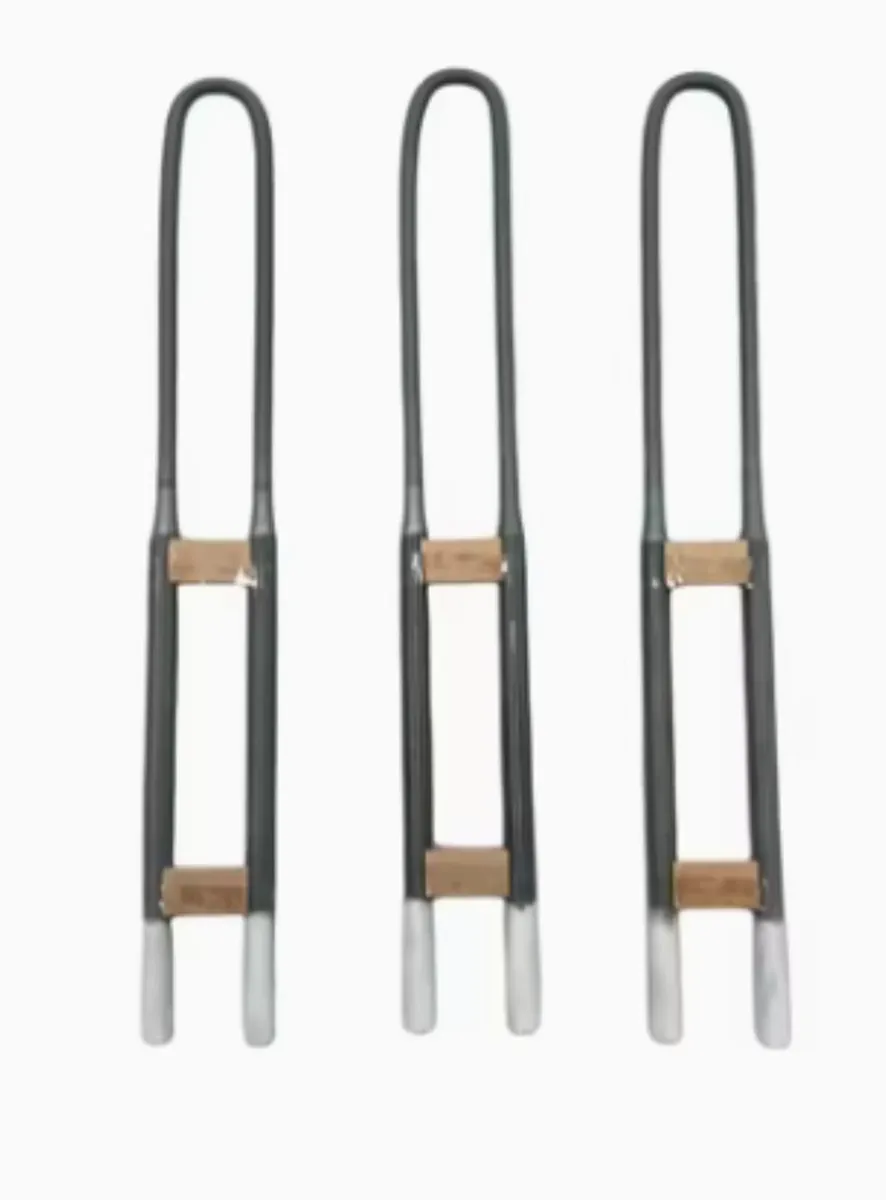
Ivoclar, Programat, VITA, ZYRCOMAT, Shenpaz, Sintra, Nabertherm and Schupp are names of their respective owners, used only to identify the documents cited. PMEXO is an independent supplier of replacement heating elements and is not affiliated with or endorsed by any of these companies. Photos show the element type, not a part of these furnaces.
Request a quote
Send the part number, or a photo of the old element with the dimensions. We reply by email with the size line we read and anything missing.