
01Furnace model · Nabertherm
Nabertherm LHT 01/17 D and LHT 03/17 D heating element replacement
Nabertherm’s operating instructions describe special molybdenum disilicide elements, the oxide layer that protects them and the oxidation firing after replacing them. Single MoSi elements can be replaced separately. Send the type-plate details and a photo of the old element.
SendLHT model + serial number + photo with ruler
Last updated 20 October 2026
Nabertherm documents: what they say
From the LHT 01/17 D – LHT 03/17 D operating instructions [1] and Nabertherm’s dental FAQ [2].
| Topic | What the document says |
|---|---|
| Maximum temperature | Tmax 1650 °C; furnace chamber of 1 or 3 litres [1]. |
| Heating elements | Special molybdenum disilicide heating elements [1]. The number per furnace is not stated in the manual. |
| Protective layer | Above 800 °C a silicon oxide layer forms on the element surface and protects it against further oxidation [1]. |
| Yellow powder | On unprotected elements, oxidation around 550 °C can leave a yellowish powder, mainly MoO3; Nabertherm states this has no disadvantageous effects on the performance of the heating element [1]. |
| After replacing | Run the pre-set oxidation firing (program P5) to create a protective oxide coating – on start-up, when heating elements have been replaced, or to regenerate the oxide layer [1]. |
| What wears elements | Paint solvents can lead to accelerated wear (pre-dry well if solvents are used), and the elements should never come into contact with solid materials [1]. |
| Who replaces | Nabertherm recommends that two people replace heating elements, and suggests photographing the cables on the elements and the switchgear first [1]. |
| Single or set | With MoSi heating elements, individual defective elements can be replaced separately; for a quotation Nabertherm asks for the furnace serial number [2]. |
“Not published” means we did not find it in the documents listed under Sources; it may exist in service documents we have not seen.
Before you order
- A yellowish powder after use at low temperatures is MoO3 from oxidation around 550 °C; Nabertherm states it has no disadvantageous effects on element performance [1].
- A cracked or broken element: with MoSi elements, a single element can be replaced [2].
- Check what goes into the furnace: Nabertherm warns that paint solvents accelerate element wear [1].
What to send for an LHT 01/17 D / 03/17 D
- Type plate: furnace model, serial number, article number, year of construction [1]
- Photo of the old element next to a ruler, and photos of the cables
- Diameters of heating zone and terminal, if you can measure
- Heating length Le, terminal length Lu and leg spacing a
- Which element failed, and how many you want to replace
- Item number from the box or invoice, if you have one
One defective element is enough to ask about
Nabertherm writes that MoSi heating elements can be replaced individually [2]. Tell us which element failed; we read its size from the photo and write it back to you.
Follow Nabertherm’s operating instructions for removing and installing elements; Nabertherm recommends two people [1]. Other furnaces: dental furnace models.
How the furnace-model check works
Send
The furnace model and a photo of the old element, or its part number. Dimensions if you can measure.
We check and confirm the spec
We check the dimensions and reply in writing with the size line we read, any missing value, and whether we can supply it.
You confirm the configuration
Size, number of elements per set and, for SiC rods, how they are grouped by resistance.
Production and shipping
Production and shipping are arranged for the confirmed configuration; the quote covers that element and quantity.
Dental furnace service, dealers and labs: see dental sintering furnaces for typical situations.
Questions buyers ask
Which heating elements does the LHT 01/17 D use?
Special molybdenum disilicide heating elements, according to Nabertherm’s operating instructions [1]. The manual does not give their dimensions; we read the size from the old element.
Can I replace one element only?
Nabertherm writes that with MoSi heating elements, individual defective elements can be replaced separately, while the SiC elements in its LHTCT furnaces are only replaced as a complete set [2].
Is the yellow powder a problem?
Nabertherm describes a yellowish powder, mainly MoO3, from oxidation of unprotected elements around 550 °C, and states it has no disadvantageous effects on the performance of the heating element [1]. In a test published by Schupp, a supplier of MoSi2 elements, zirconia samples treated with MoO3 showed no discoloration [3]. More in the discoloration guide.
Are these Nabertherm original parts?
No. PMEXO is an independent supplier of replacement heating elements and is not affiliated with Nabertherm.
Sources
- Nabertherm: Operating Instructions, High-Temperature Furnace (Tabletop Model) LHT 01/17 D – LHT 03/17 D, M01.1068 English, 2025-01 (PDF)
- Nabertherm: Sintering furnaces for dental – FAQ about sintering furnaces
- M.E. Schupp Industriekeramik: Discoloration free sintering with high purity molybdenum disilicide (MoSi2) heating elements (PDF). Technical article by a supplier of MoSi2 heating elements
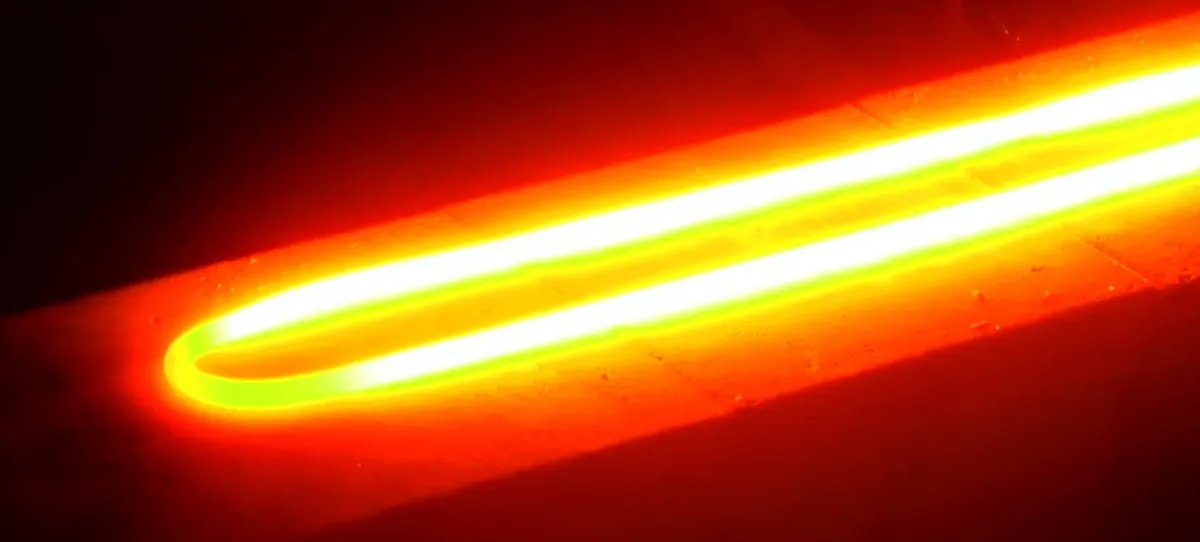
Nabertherm and the model names on this page belong to their respective owners and are used only to identify the furnace. PMEXO is an independent supplier of replacement heating elements and is not affiliated with or endorsed by Nabertherm. Photos show the element type, not a part of this furnace.
Request a quote
Send the part number, or a photo of the old element with the dimensions. We reply by email with the size line we read and anything missing.