
01Guide · MoSi2 elements
MoSi2 heating element sizes: 3/6, 4/9, 6/12 and how to measure
A MoSi2 size such as 4/9 gives two diameters – heating zone and terminal, in mm. It does not give the lengths, the leg spacing or the shape, and a replacement needs all of them. What the numbers mean, Kanthal’s standard values, and how to measure an old element.
Size lined/c · Le · Lu · a · shape
Last updated 20 October 2026
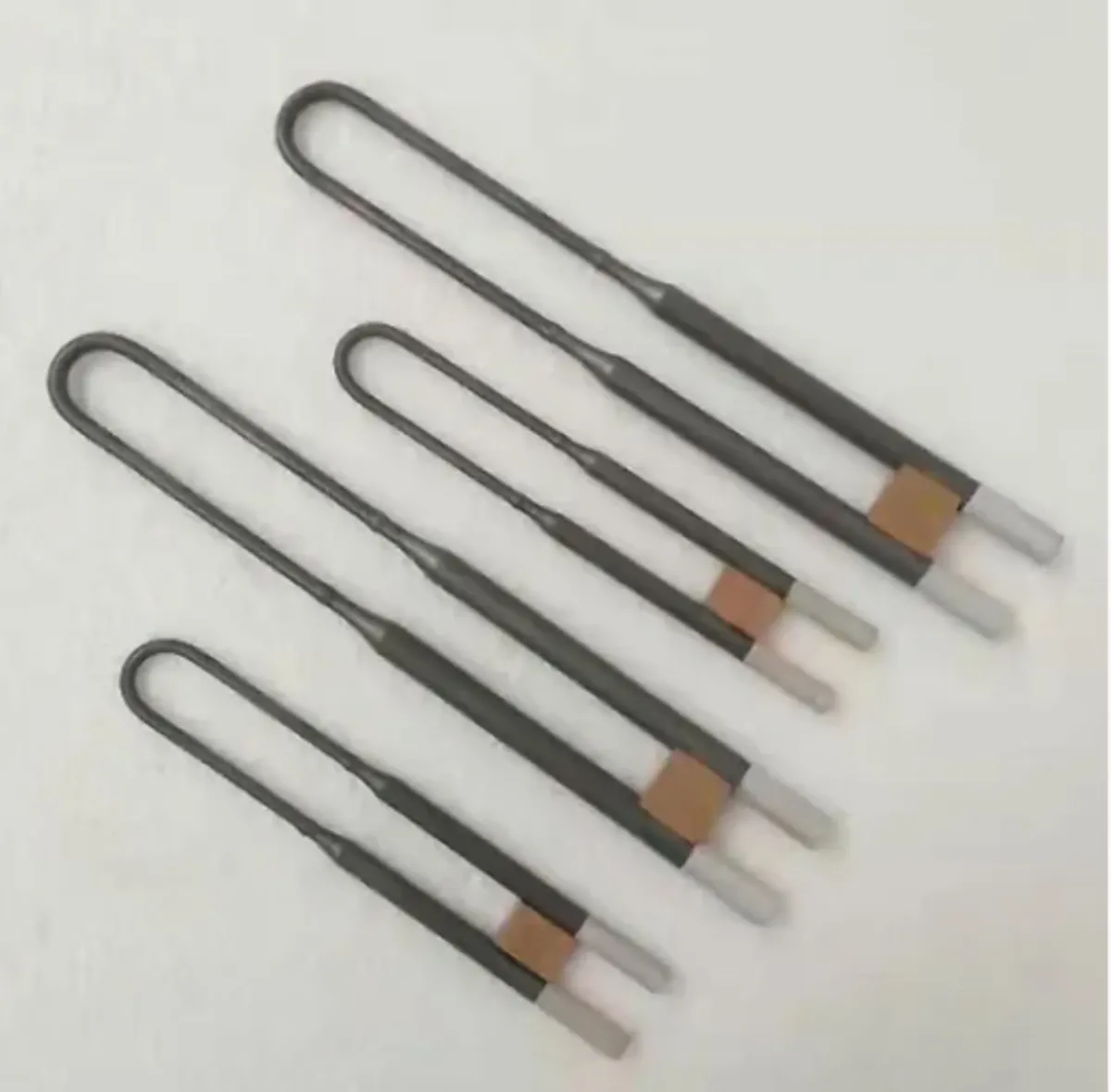
Sizes: what 3/6, 4/9 and 6/12 mean
The two numbers are the diameter of the heating zone and the diameter of the terminal, in mm. Kanthal lists 3/6, 4/9, 6/12, 9/18 and 12/24 as standard sizes for its MoSi2 elements, and writes that the heating zone is welded to terminals which normally have twice its diameter [1].
The size does not tell you the heating length, the terminal length, the leg spacing or the shape. Two 4/9 elements can differ in all four.
| Size d/c | Heating zone Ød | Terminal Øc | Leg spacing a, standard value |
|---|---|---|---|
| 3/6 | 3 mm | 6 mm | 25 mm |
| 4/9 | 4 mm | 9 mm | 25 mm |
| 6/12 | 6 mm | 12 mm | 50 mm |
| 9/18 | 9 mm | 18 mm | 60 mm |
| 12/24 | 12 mm | 24 mm | 80 mm |
From Kanthal’s table of sizes and shapes [1]. Kanthal marks a as a standard value and also designs elements to customer needs, so measure a on your old element instead of assuming it.
| d/c | Heating-zone / terminal diameter in mm, e.g. 3/6, 4/9, 6/12 |
|---|---|
| Le | Heating zone length |
| Lu | Terminal length |
| a | Centre-to-centre distance of the two legs |
| shape | Straight U, bent 45° or 90°, or four-shank |
What to send
- Furnace brand and model, or the item number of the element
- Photo of the old element next to a ruler, both legs in the picture
- d and c, e.g. 4/9 – with a caliper if you have one
- Le, Lu and leg spacing a
- Straight or bent: the angle and where the bend is
- How many elements you need
Shapes and grades
Kanthal describes the two-shank U element as the most common design. It can be bent 45° or 90°, either in the heating zone or in the terminals; Kanthal’s examples also include straight terminals and a four-shank element for horizontal use [1].
On an element bent at the terminals, Kanthal’s drawing counts the bend as part of the terminal length: Lu = m + k + l – the straight part above the heating zone, the bend, and the part after the bend [1]. Measure along the element, through the bend.
The size line says nothing about the grade. Kanthal, for example, lists its Kanthal Super grades 1700, 1800, 1900, RA, ER, HT and NC [1]. Note any marking on the old element, its box or the invoice.
How to measure: an old element, step by step
- Switch off, unplug and wait until the chamber is completely cold. Shenpaz asks for the main power off, the furnace unplugged and the muffle completely cold before elements are replaced [2].
- Before removing anything, take several photos of the cables on the elements and of the connections. Nabertherm recommends this because it simplifies installing and wiring the new elements [3].
- Handle the elements gently. Shenpaz warns that they are very fragile and may break under minimal force [2].
- Lay the element flat next to a ruler and photograph it square-on, with both legs and both terminal ends in the picture.
- Measure d on the thin heating zone and c on the thick terminal, with a caliper if you have one.
- Measure Le from the bottom of the U to where the terminal begins, Lu from there to the terminal end, and a from the centre of one leg to the centre of the other [1].
- For a bent element, note the angle and where the bend is, and measure Lu along the element [1].
Broken element?
Still worth measuring. Lay the pieces out in order next to a ruler and photograph them; send the photos with what you could measure.
Questions buyers ask
What does 4/9 mean on a MoSi2 element?
A heating-zone diameter of 4 mm and a terminal diameter of 9 mm. Kanthal lists 3/6, 4/9, 6/12, 9/18 and 12/24 as standard sizes [1]. Heating length, terminal length and leg spacing are separate measurements.
What is the leg spacing of a 6/12 element?
Kanthal gives 50 mm centre to centre as the standard value for 6/12 [1], but it also designs elements to customer needs. Measure a on your old element rather than assume it.
Can a broken element still be measured?
Usually, yes. Lay the pieces out in order next to a ruler and photograph them. Handle them gently: Shenpaz warns that heating elements are very fragile and may break under minimal force [2].
Sources
- Kanthal: Kanthal® Super sizes and shapes (MoSi2 heating elements). Standard sizes, element shapes and dimension drawings, read 20 October 2026
- Shenpaz: SINTRA / SINTRA PLUS instruction manual, Ver. 0.7.8, September 2018 (PDF). Section “Replacing Heating Elements”
- Nabertherm: Operating Instructions, High-Temperature Furnace (Tabletop Model) LHT 01/17 D – LHT 03/17 D, M01.1068 English, 2025-01 (PDF). Section on replacing the heating elements
Kanthal and Kanthal Super are trademarks of their owner; Shenpaz, Sintra and Nabertherm are names of their respective owners. They are used only to identify the documents cited. PMEXO is an independent supplier of replacement heating elements and is not affiliated with or endorsed by these companies. Photos show the element type.
Request a quote
Send the part number, or a photo of the old element with the dimensions. We reply by email with the size line we read and anything missing.