
01Guide · SiC elements
SiC heating element resistance: ageing, measuring and matching
Silicon carbide elements gain resistance in use. That is why a new rod in an aged set can overload the new or the old rods, and why a SiC replacement needs a resistance value as well as a size. This guide follows Kanthal’s Globar brochure, with a source for each figure.
Sendsize + resistance or test current + wiring
Last updated 20 October 2026
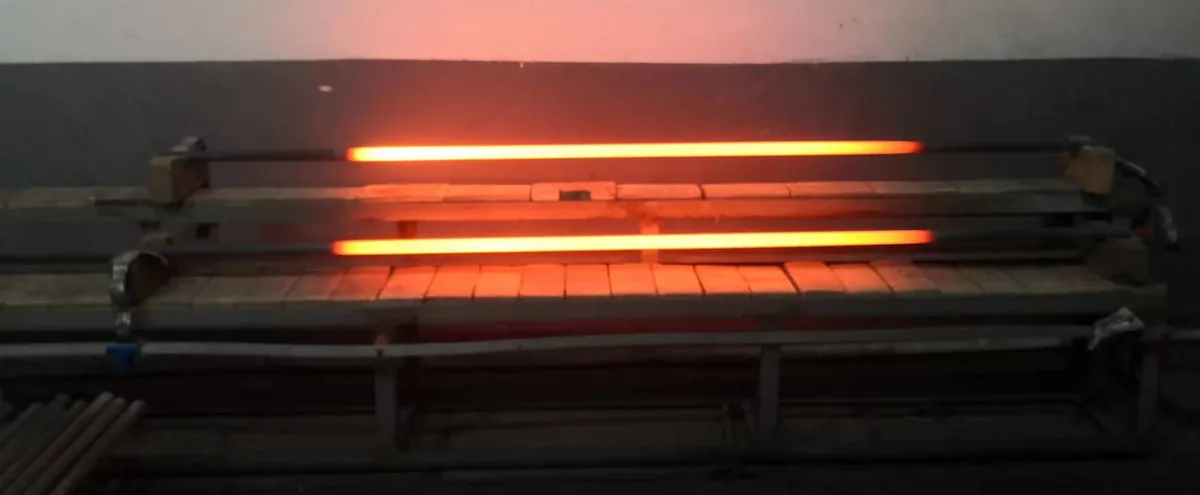
Ageing: why SiC rods gain resistance
All silicon carbide elements increase in resistance in operation. The brochure names the factors: furnace temperature, surface loading in W/cm², the atmosphere around the elements, continuous or intermittent operation, and operating practice and power control [1].
As a general guide, Globar AS and SD elements may gain about 5–6 % per 1,000 hours of continuous operation in clean air at 1,400 °C, and about 3 % per 1,000 hours at 1,000 °C. Small changes in operating conditions can alter these rates considerably [1].
Voltage reserve
To keep full power as resistance rises, a variable-voltage supply is usually provided. The reserve depends on the rate of increase and is usually 50–100 % of the voltage that delivers full power with new elements: if new elements need 125 V, a 125–250 V range gives 100 % reserve and 125–187.5 V gives 50 % [1]. For long periods at about 1,400 °C or above the brochure allows 100 %; for very low element temperatures or infrequent use, 50 % or less may be enough [1].
Measuring: hot, not cold
Minute variations in minor impurities have a disproportionate effect on the cold resistance, and room-temperature readings give no indication of the resistance at working temperature [1]. The brochure measures at a constant temperature of at least 1,000 °C: the voltage across each element divided by the current through it [1].
Nominal resistance refers to an element temperature of 1,000 °C and has a standard tolerance of ±15 % [1] – much wider than the ±5 % recommended between rods in series. That is why rods are matched by measured values, not by the nominal value. Each new Globar element is marked with a standard test voltage and the test current at that voltage; the test current is used when matching element resistances [1].
Before old elements are removed, the brochure suggests taking voltage and current readings from each one and marking the increased resistance on the terminal, to help with matching later [1].
Readings on a live furnace are work for a qualified electrician, following the furnace’s own documents.
Matching rules
From the Globar brochure’s sections on element connections and matching of resistance values [1].
| Situation | What the brochure recommends |
|---|---|
| Series connection | Select elements within ±5 % resistance of each other [1] |
| Parallel connection | A wider range of ±10 % is acceptable [1] |
| Number in series | Up to four Globar AS or SD elements, if well matched; at furnace temperatures above 1,400 °C, limit it to two [1] |
| U and CU types | Recommended maximum of two in series [1] |
| Series-parallel | Usually an effective compromise; connect the series groups in parallel [1] |
| Mixed element types | Never in the same circuit: their resistance rises at different rates, which overloads one type or the other [1] |
| Control groups | Keep them small to simplify matching later – 48 elements are more flexible as 8 groups of 6 than as 3 groups of 16 [1] |
One new rod, or the whole group?
If an element fails or breaks after only a short period of use, it can usually be replaced with a new one, preferably from the higher end of the resistance tolerance (lower amperage) [1].
If the elements have been in use for a considerable time, the brochure says to replace the entire group; otherwise an excessive load falls on either the new or the old elements [1]. The old elements may be kept for later use alongside others that have run for a similar period [1].
After a group change, set the output voltage of the power supply to the correct value before switching on: overloading the elements even for a very short period can cause irreparable damage [1].
Keep the elements dry
Elements exposed to water vapour, even for a short time, are seriously damaged and never revert to normal oxidation, even in dry air. Dry the furnace thoroughly before the elements are installed; if they must be used for drying, ventilate the furnace well and allow no steam build-up [1].
What to send for a SiC replacement
- Photo of the old rod next to a ruler, with both ends in the picture
- Diameter, heating-zone length and cold-end lengths, as far as you can measure
- Shape: straight rod, U-type or other
- Resistance, or the test voltage and current marked on the rod, if readable
- How the rods are connected – series, parallel or series-parallel – and how many per group
- How many rods you replace, and roughly how long the others have run
Element pages: SiC heating rods Ø25, straight · SiC U-type rods Ø25 · dental-furnace SiC elements
Values on this page
All figures come from Kanthal’s Globar brochure and apply to Globar elements. Other SiC elements can behave differently; follow the documents for your furnace and elements.
With a SiC request we write back the size line we read and how the rods are to be grouped by resistance, for you to confirm.
Questions buyers ask
Can I replace just one SiC rod?
After only a short period of use, usually yes – preferably with a rod from the higher end of the resistance tolerance. After a considerable time in use, the Globar brochure says to replace the whole group [1].
Why is a cold resistance reading not enough?
Because room-temperature readings give no indication of the resistance at working temperature. The brochure measures at a constant temperature of at least 1,000 °C, dividing the voltage across each element by the current through it [1].
How closely must the resistances match?
Within ±5 % of each other for elements in series and within ±10 % for elements in parallel, according to the Globar brochure [1].
Sources
- Kanthal: Globar® SiC heating elements – engineered for versatility (PDF brochure, 30 pages, Globar AS and SD elements). Sections on element performance, electrical specifications, element connections, matching of resistance value and voltage reserve
Kanthal and Globar are trademarks of their owner, used only to identify the document cited. PMEXO is an independent supplier of replacement heating elements and is not affiliated with or endorsed by Kanthal. The values on this page are from the Globar brochure and may differ for other elements. Photos show the element type.
Request a quote
Send the part number, or a photo of the old element with the dimensions. We reply by email with the size line we read and anything missing.